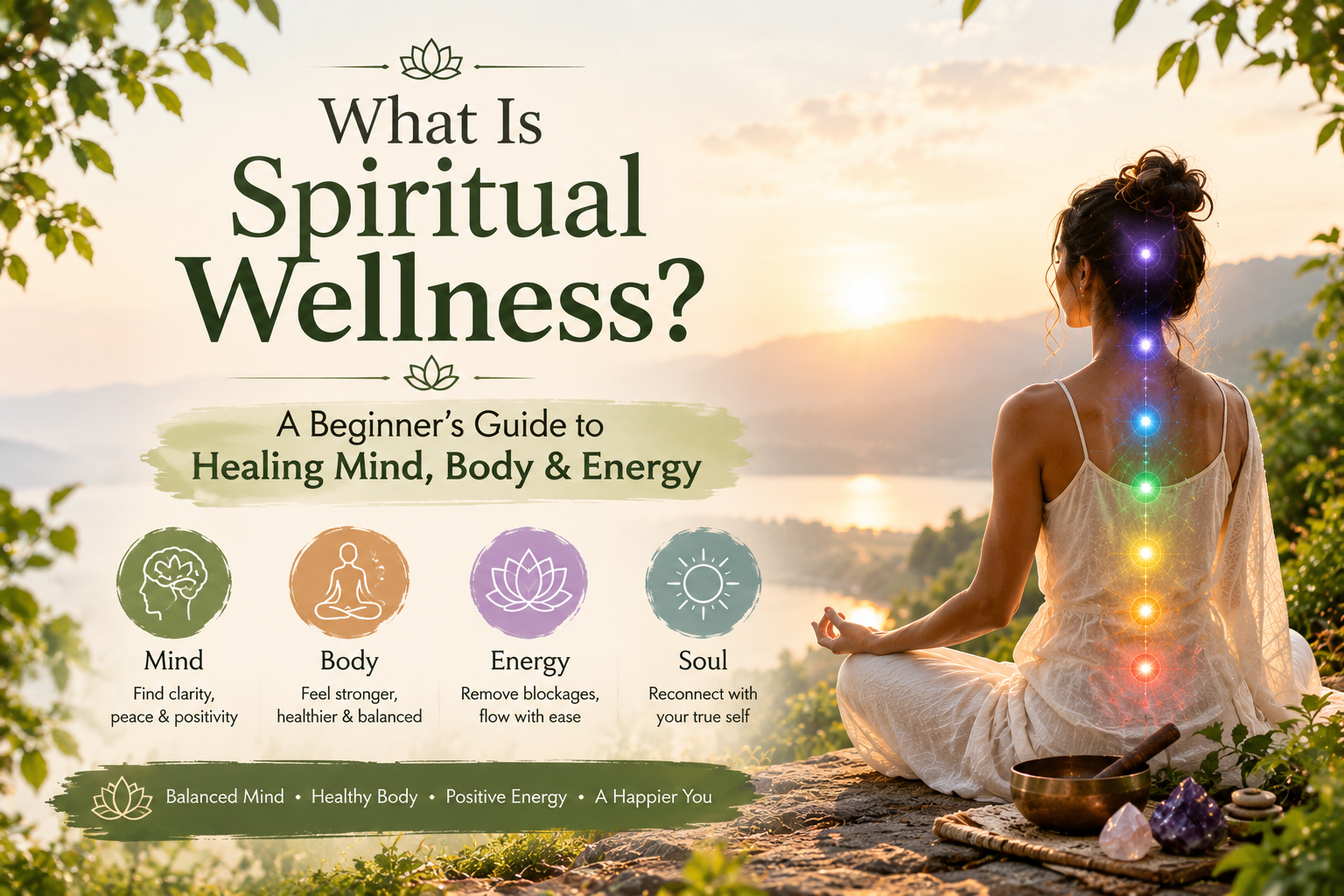
What Is Spiritual Wellness? A Beginner's Guide to Healing Mind, Body & Energy
In today\'s fast-paced world, taking care of your physical health is only one part of living a balanced life. True wellbeing also involves your thoughts, emotions, inner connection, and sense of purpose. This is where spiritual wellness comes into the picture.
Spiritual wellness is not necessarily about religion or following a particular belief system. It is about developing a deeper connection with yourself, finding inner peace, understanding your values, and creating a greater sense of meaning in everyday life.
What Is Spiritual Wellness?
Spiritual wellness is a state of inner balance in which your mind, body, emotions, and personal sense of purpose are connected.
It encourages you to slow down, become more aware of your thoughts and feelings, and explore what gives your life meaning. Practices such as meditation, mindfulness, yoga, conscious breathing, self-reflection, and certain traditional spiritual practices can support this journey.
For some people, spiritual wellness may involve connecting with nature or a higher power. For others, it may simply mean developing greater self-awareness and inner calm.
There is no single definition or path that works for everyone.
Why Is Spiritual Wellness Important?
Modern life can leave us constantly distracted, stressed, and mentally exhausted. Work, social media, technology, and everyday responsibilities can make it difficult to pause and reconnect with ourselves.
Spiritual wellness encourages intentional moments of stillness and awareness.
A regular spiritual practice may help you:
-
Develop greater self-awareness
-
Create moments of calm and reflection
-
Become more mindful of your thoughts and emotions
-
Connect with your personal values and purpose
-
Develop a deeper sense of gratitude
-
Build healthier relationships with yourself and others
-
Create a more balanced approach to everyday life
Spiritual wellness is not about escaping everyday life. Instead, it can help you approach life with greater awareness and presence.
Spiritual Wellness and the Mind
The mind is constantly processing information, memories, emotions, and experiences. When we rarely give ourselves time to pause, our thoughts can become overwhelming.
Meditation and mindfulness are simple ways to begin developing a more peaceful relationship with the mind.
Instead of reacting automatically to every thought, mindfulness encourages you to observe your thoughts without immediately judging them. Over time, this practice can help you become more aware of your mental patterns.
Even a few minutes of quiet breathing or meditation each day can become a valuable part of a spiritual wellness routine.
Spiritual Wellness and the Body
The mind and body are closely connected. How we sleep, breathe, move, eat, and rest can influence how we feel emotionally and mentally.
Spiritual wellness encourages you to become more conscious of your body rather than treating it simply as something that carries you through the day.
Practices such as yoga, mindful breathing, meditation, walking in nature, and conscious relaxation can encourage greater awareness of physical sensations and help create moments of relaxation.
The goal is not perfection. It is learning to listen to your body and treat it with greater awareness and care.
Understanding Energy in Spiritual Wellness
Many traditional spiritual traditions use the concept of energy to describe the subtle forces associated with life, awareness, and wellbeing.
Concepts such as chakras, prana, and energetic balance appear in different Indian spiritual traditions and are interpreted in different ways.
From a spiritual perspective, practices such as meditation, breathwork, yoga, and Tantra may be used to cultivate awareness of these subtle dimensions of experience.
It is important to approach these practices with an open but grounded mindset. Spiritual practices can support personal reflection and wellbeing, but they should not be presented as substitutes for professional medical or mental-health care.
Simple Ways to Begin Your Spiritual Wellness Journey
You do not need to completely change your lifestyle to begin exploring spiritual wellness.
Start small.
1. Spend a Few Minutes in Silence
Set aside five to ten minutes each day without your phone, television, or other distractions. Simply sit quietly and notice your breathing.
2. Practice Mindful Breathing
Take slow, comfortable breaths and bring your attention to the movement of your breath. When your mind wanders, gently return your attention to breathing.
3. Start a Gratitude Practice
Before going to bed, think about three things you genuinely appreciate. They can be simple moments, people, experiences, or lessons.
4. Spend Time in Nature
A quiet walk outdoors can create an opportunity to disconnect from digital distractions and reconnect with your surroundings.
5. Explore Meditation
Meditation does not have to involve long sessions. Beginners can start with just a few minutes and gradually develop a consistent practice.
6. Practice Self-Reflection
Ask yourself questions such as:
What truly matters to me?
What gives my life meaning?
What habits are helping me grow?
What do I need to let go of?
There are no perfect answers. The value comes from honestly exploring the questions.
Spiritual Wellness and Tantra
Tantra is one of the traditional approaches that can be explored as part of a broader spiritual journey. Contrary to some modern misconceptions, Tantra is not simply about sexuality. Traditional Tantra encompasses practices involving awareness, meditation, energy, consciousness, ritual, and the relationship between the individual and the larger existence.
When approached responsibly, Tantra can be explored as a path toward deeper self-awareness and conscious living.
At AAdi Spiritual, spiritual practices can be approached as opportunities for self-exploration, mindfulness, connection, and inner growth.
Is Spiritual Wellness the Same as Religion?
Not necessarily.
Religion may involve specific beliefs, traditions, communities, rituals, and forms of worship. Spiritual wellness can exist within a religious tradition, but it can also be explored independently.
Someone may find spiritual wellbeing through meditation, nature, self-reflection, yoga, service, prayer, or other practices.
The important question is not whether you follow a particular label, but whether your practices help you develop greater awareness, connection, meaning, and inner balance.
Creating Your Own Spiritual Wellness Routine
A sustainable spiritual practice should fit naturally into your life.
You could create a simple daily routine such as:
Morning: 5–10 minutes of meditation or mindful breathing
During the day: Take short mindful pauses between activities
Evening: Reflect on your day and practice gratitude
Weekly: Spend time in nature, attend a meditation session, or explore a spiritual practice
Consistency is more important than doing everything at once.
Final Thoughts
Spiritual wellness is ultimately about creating a deeper relationship with yourself and the life you are living.
It invites you to slow down, become more conscious, listen to your inner world, and discover what gives your life meaning.
Whether you begin with meditation, mindfulness, yoga, Tantra, nature, gratitude, or simple moments of silence, the journey can start with one small step.
Your spiritual wellness journey does not have to be complicated. Sometimes, it begins simply by becoming present with yourself.
Explore your path toward greater awareness, balance, and inner connection with AAdi Spiritual.